JOHN FAIRHURST STOREY
1887 - 30 November 1918
At School 1898 - 1901
Cpl WR/296000 Railway Directorate HQ Royal Engineers
John was born in Didsbury and, in 1891, aged 3 was living at 7, Grove Street, Didsbury, with father John, a railway clerk, mother Sarah, an elder brother, two elder sisters, grandmother, two uncles and a domestic servant. The uncles were also railway clerks. By 1901, the family had moved to 6, Oak Bank Avenue (now Silverwood Avenue), Chorlton-cum-Hardy, and John was attending School. Not much is known of his School career save that he entered with a Public Elementary School Scholarship from Christ Church School, Didsbury, proceeded through 3rd, Lower 4th and Upper 4th Forms Modern Languages and sang as a first treble in the choir in 1898 and 1899. On leaving School John also joined the railways, in 1911 being an estate clerk in Manchester for the London and North Western Railway Company, while his father had been promoted to a Railway Traffic Canvasser, essentially a salesman of railway services to local businesses.
On 17th July 1914, John married Maggie Downs at the Moss Side Gospel Hall, Bramhall and on 1st April 1916, their son Ian was born.
On 29th January 1917 John joined the Royal Engineers for duty and at some time later was posted to the Railway Directorate H Q in Salonika, (now Thessaloniki) Greece.
Between 1915 and 1918, British troops were part of a multinational Allied force fighting against the Bulgarians and their allies in the Balkans. Serbia, an ally of Britain had been defeated in October 1915, and the supporting Anglo-French troops were retreating towards Salonika.
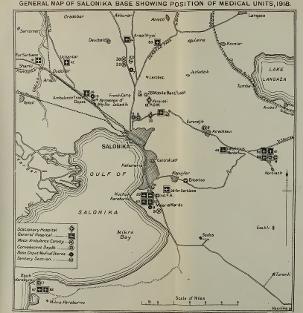
It was decided to oppose the threat of the Bulgarian, Austrian and German armies in the Balkans by landing forces at the vital port of Salonika in Northern Greece. Greece at this time was neutral and in some political turmoil, King Constantine was pro-German, while his prime minister supported the Allies. The Greek Government has taken control of all the three railways in Macedonia, hitherto owned by private companies, which, however, were not properly organised or in good repair. There were no roads to the front and the allied troops depended on the two railways to Doiran and up the Vardar Valley, single lines with passing places separated by as much as twenty six miles. The Royal Engineers set to to improve the infrastructure, with new marshalling yards and railway lines laid around Salonika, but it was not until the end of 1916 that the base area was properly developed and running well, the Allies having taken over the railways from the Greeks during the year. Improvements continued in 1917 and in 1918, from a service of less than one train a day to the Doiran front in 1915 the service was now running a regular fifteen trains a day. It was in this scenario that John found employment in the Railway Directorate H Q.
After three years of deadlock the Bulgarians were eventually forced to retreat along their entire front in September 1918; pursued by the Allies, the retreat became a rout, and on 30th September an armistice was signed.
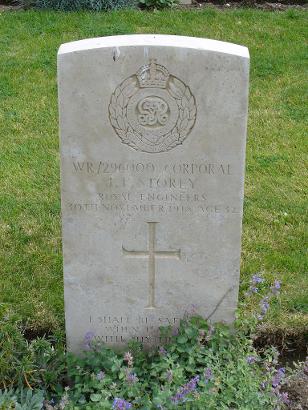
In September too, the influenza epidemic began which raged for three months. Unfortunately John succumbed to the virus and died of Broncho Pneumonia on 30th November 1918 at 48th General Hospital. He was buried in Kirechkoi-Hortakoi Military Cemetery, which is three quarters full of flu victims.
Administration was granted on 29th January 1920 to Maggie Storey, widow. Effects £266 13s 1d. Maggie was granted a pension of 33/5d a week from 4th August 1919.
The Hulmeian - December 1920
November 29th, 1918, at Salonica, of pneumonia, John Fairhurst Storey, Corporal, Royal Engineers, son of Mr and Mrs D Storey, Cheadle Hulme. (At School, 1898-1901)