OLIVER JEPSON SUTTON
29 July 1882 - 23 March 1918
At School 1891 to 1896
Capt 9th Manchester Regt
Oliver was born in Manchester and in 1891, aged 8, was living at 121 Chorlton Road, Stretford with father Charles, a widower, elder brothers Charles and John, younger brother Albert and 2 domestic servants. Charles was the chief librarian of Manchester from 1879 to 1920 and Oliver followed in his footsteps; by 1911 he was an Assistant Librarian at John Rylands Library in Manchester. Oliver's mother had died in 1889 and his father remarried in 1892 and by 1901 the family had moved to 284 Great Clowes Street, Broughton and by 1911 to 323 Great Clowes Street.
On the outbreak of war Oliver joined the Manchester Regiment and on 2 September 1914 was commissioned 2nd Lieutenant in the 9th Battalion. The 9th was a Territorial Army Battalion attached to the 42nd East Lancashire Division, and left for Egypt on 10 September 1914, arriving at Alexandria on the 25th. On the 27th the Battalion moved to Cairo to the

Kasr-el-Nil barracks on the banks of the River Nile. A letter sent from the Kasr-el-Nil Barracks, Cairo, by Lieut. Colonel D.H.WADE, Commanding Officer of the 9th Battalion was published in the Ashton Reporter on October 31st 1914, " There are about 1500 troops in the barracks.
The Officers quarters are fair, and so would the men's be if it were not for the bugs. Work is principally done before 10 am. We fall in at 5.45 am, we also have parades later in the day, but we have to keep the men in the shade. So far we have been sweltered in our thick clothing. Food is good, and the vegetables particularly so. The men are allowed out of barracks after 6.30 pm and must return by 10 pm". The Ashton Reporter also published a letter from one of the men: "An interesting letter has been received from Private 1718 DAVID THORP, descriptive of the enjoyable life of the Territorials in Egypt. Writing to a Stalybridge friend, he says: - " I am pleased to write to you once again, now that we have arrived at our destination, which is a grand place. The people here seem queer to us, but, of course, they are a different class of people altogether to us. I wish you could have come with us, as it would have suited you to see these people in the streets. The sun is scorching all through the day, and we are almost like blacks now, and they call it winter, so I don't know what it is going to be like in summer. The barracks that we are in is a large one, having four wings to it. We have nothing to grumble about. The buildings are simply grand out here; everything seems new, and there is no smoke in the air like there is at home. We can get English papers, but they cost us twice as much. The thing that is puzzling us most is the money, the commonest coin being a piastre, which is 2½d. in our money. I will bring some of these coins home with me, and then you will be able to see what they are like. We have all been provided with light suits and helmets, and we had plenty of fun out of them when we put them on for the first time. We have not been allowed out of barracks yet, but we are expecting being free soon, and then we shall be able to see the sights and habits of Egypt better. We have seen three funerals since we arrived here, and they looked more like picnic parties, for the mourners ride on donkeys, and they all seem to be laughing and singing, whilst two of them carry the coffin. There are scores of camels passing in the streets with loads on their backs, and it does not seem strange to see them now, as it did at the first. The river Nile runs past one side of the barracks, and it is a grand sight to see the boats floating up and down. The houses around here are all surrounded with trees, and the streets are wide and clean. There are plenty of white people here, but most of those are French. The railway that we travelled on from Alexandria to Cairo was treat, as we went through several streets on the journey, and we could almost touch the walls of the houses with our hands. We have done very little work up to now; in fact it made blisters come on my hands when I cut some bread, so you can tell how soft they are getting through want of use. This fresh air is making a man of me, and I feel different altogether to what I did when I was shut up all the day in the mill. If you are working full time, you are welcome to it, for I am not ready for it yet, as I am quite satisfied with my present job, and it makes me laugh to think how you poor chaps are running round and cursing the bad spinning, whilst I don't know how to pass the hours of the day over." The Ashton Reporter published further letters: P 1637 Herbert Fish "I have been to see the Pyramids and Sphinx. They are fine things. Some of the stones are as big as our houses at home. Inside the base of the Pyramids are dozens of bazaars and shops. We do our marching at night instead of in the day time. We set out at eight o'clock and get back at eleven o'clock. It is simply fine. Talk about seeing life, it is not in it. If I had missed my chance of coming out here I should never have forgiven myself."
"P 1725 WILFRED COLCLOUGH, 9th Battalion, E Company, writes to his parents of Arlington St. from Cairo, " We are all in mess rooms, 18 men to a mess. We all have proper beds, and the food is excellent, we have had as much as we could eat at every meal, and we have had no need to spend any money outside the barracks. Everything you require you can get inside the barracks, even to shirts, towels and soap etc. We are allowed out of the barracks each evening, but we must return by 10pm. With it being our first Sunday here, we have just finished Church Parade. I think we are allowed out after 2pm, so we are going to see the Sphinx and the Pyramids. We are about a mile from the centre of the City. The weather here is boiling hot through the day and then it suddenly goes very cold and very dark at night. The water supply is very good and we use as much as we want".
Private J.A. BOSTOCK, of Park Road, Dukinfield, sends a highly descriptive letter. He writes that the battalion has a great deal of drilling to do, and it is very hard work. The men, however, are keeping in the best of health, although the weather is toasting hot. In the Kasr-el-Nil Barracks there are 1400 troops, and he adds : "They are beginning to look very smart indeed. We have nothing to complain of but millions of bugs. You would laugh if you saw us in our shirts chasing them in the night. There are sixteen of us in this room, and each of us with a shoe go galloping about. There are four hundred rooms in the barracks, so you can imagine what a large place it is. Cairo is a beautiful city, but fearfully dirty. I have been out twice for a walk in addition to route marches, but I was disgusted with what I saw. We have, however, plenty of fun. When the natives see us coming they run for their lives, shouting Allah! Allah! Allah! When they get out of our way they pull their tongues out, spit and dance, and appear to be highly pleased with themselves. It is Christmas here from October 30th to November 3rd, and no one is allowed to leave barracks. The reason for this is that there would be a possibility of trouble with the natives, who wash their feet in the street and sing all day." Egypt, he added, is 2700 miles from England.
The Battalion underwent strenuous training over the next few months and in April left Cairo for the Suez Canal area, but the good life would soon be over as they were then ordered to Gallipoli,
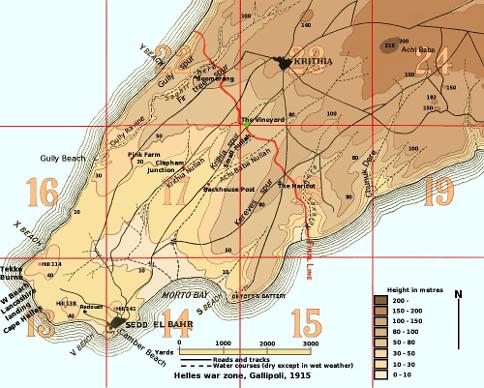
embarking on 5 May aboard RMS Ausonia at Port Said and landing at V Beach, Sedd-el-Bahr on 9 May under heavy fire, however few casualties were sustained. The Battalion moved from the beach to bivouacs and on the 21st moved into the line inRedoubt Trenches.

The Battalion was relieved on 25 May and on the 26th 2 Companies were attached to the the Indian Brigade and 2 to the 87th Brigade, returning on 29 May and 1 June respectively. On 3 June the Battalion moved up to the 3rd line trenches, as part of the 42nd East Lancashire Division, beginning weeks of front line duties for the Division. The Battalion undertook the establishment of rifle pits in front of the front line, straightening of the trench lines, reconnaissance of and attacks on the Turkish trenches and holding the line. On 7 August, two platoons under Oliver proceeded to reinforce the firing line at 14.30 hours; shortly after arrival Oliver was wounded by shrapnel and eventually had to go back to the Casualty Clearing Station.
The Hulmeian - December 1915
"Lieutenant O J Sutton was wounded in the right shoulder by shrapnel on August 7th at Gallipoli. He has been mentioned in despatches, and, we understand, recommended for the Military Cross. He volunteered to make a reconnaissance of the enemy’s new trenches, and on successive nights crawled out across the No man’s Land, measuring the extent of the new works and taking the range from our lines."
Sergeant Harry Grantham, who was awarded the DCM described the event to the Ashton Reporter: "Lieut Sutton and myself went out two nights in succession, July 10th and 11th. We each took a piece of rope with us, attached to our wrists and to the parapet of our trench. We pulled it along with us until we reached the Turkish trenches, and so were able to measure the distance between our trenches and theirs. The Turks saw us, but we ran about five or ten yards, and then lay flat on the ground among dead Turks. It was somewhat exciting, especially when they fired at us, but luckily we were missed. Both General Prendergast and General Douglas congratulated us."
The Hulmeian - April 1916
Captain O J Sutton, 9th Manchester Regiment, has been awarded the Military Cross for distinguished service at Gallipoli, where he carried out valuable reconnaissance work between the lines as described in our last number.
The battalion suffered heavy casualties during their time in and around Krithia Nullah and the Vineyard, between 7th to 13th August 17 killed, 1 missing, 86 wounded. Oliver returned to the Battalion on 20 October with 12 men from the Advanced Base Details Camp, Mudros.