Old Hulmeians War Memorial 1914 - 1919

  • Home
  • The Memorials
  • Picture gallery
  • Acknowledgements
  • Contact us
  • Roll of Honour 1939-1945
  • Further Information 1939-1945
  • Roll of Honour 1914-1919
  • Old Hulmeians Lacrosse Club 1914
  • Western Front Maps
  • The Public Schools Brigade - Royal Fusiliers
  • 20th Royal Fusiliers -3rd Public Schools
  • Adshead A G
  • Allison J L
  • Bailey F
  • Batty E G
  • Beales H
  • Bearn O L
  • Bevan H J H
  • Bewley F N
  • Birchal W A
  • Blaikie M G
  • Bradbury A
  • Bradley R E
  • Brewer J W
  • Brocklebank C C
  • Brookes G B
  • Brown J H
  • Buckland H
  • Budge H E U
  • Cade R H
  • Calderwood J
  • Cartwright F
  • Cartwright W
  • Champness W
  • Chant W
  • Clayton R D
  • Cooper A F
  • Cooper C E
  • Cooper D G
  • Cosadinos D G
  • Courtman J E
  • Courtman P
  • Cox F R
  • Currie D
  • Dickinson J T
  • Dickinson L
  • Dixon A C
  • Dixon T H
  • Dorrington P
  • Dorrington W
  • Elliott A E
  • Elliott G A
  • Fox J R
  • Fraser M D
  • Golden J N
  • Gresty J
  • Harrop J
  • Hay H
  • Heron J
  • Hicks D M
  • Higginbottom F
  • Higson J T
  • Hinchliffe A J
  • Hinson H G
  • Hobdey A M
  • Holden W L
  • Holmes J W
  • Holmes V R
  • Hopwood A C
  • Horrocks W E
  • Hough F
  • Hough T M
  • Hurst E B
  • Hurst J H
  • Jefferis T F
  • Jones H O
  • Jones I M
  • Knight H H
  • McKeever J
  • Maybrick T L
  • Merchant A
  • Morris W R
  • Moss G A
  • Moss H J H
  • Mudie R A
  • Mumford J H
  • Mutch H T
  • Neill G W
  • Norquoy J
  • Palmer W H
  • Phibbs E W
  • Phibbs R A
  • Radford J S
  • Roberts J W
  • Royce E H
  • Sandiford F G
  • Sargent E S
  • Shorrocks E
  • Smith E
  • Stansby G B
  • Storey J F
  • Stromberg H C
  • Sturgeon R V
  • Sutton O J
  • Sykes R
  • Taylor D G
  • Taylor E
  • Tempest B
  • Thompson A L
  • Thompson A M
  • Thorp A E
  • Tinker A H
  • Wakeman M W
  • Walker G S
  • Walker J H
  • Whitcombe S
  • Widdowson A J H R
  • Williamson E
  • Williamson K H
  • Winrow H
  • Worlidge O G
  • Wyatt S J L


KENNETH HARPER WILLIAMSON

 14 April 1898 - 19 April 1917

 At School 1907 -1908 & 1910-1911

 2nd Lieut 7th Kings Royal Rifle Corps
Kenneth was born in Buxton, Derbyshire, and in 1901, aged 2, was living as a boarder at 45 Bath Street, Buxton with father John, Chartered Accountant, mother Margaret, elder brother George and elder sister Margaret. In 1911 Kenneth was at School and living with his grandfather George, also a Chartered Accountant, and Aunt Helen, at 21 Edge Lane, Chorlton. George was the senior partner in the firm of Williamson and White, in which John had been accepted as partner in 1894. The partnership was dissolved in 1903 at which time it appears that John retired. Not long afterwards the family moved to Tal-y-Cafn, Carnarvon, near Conwy, North Wales.

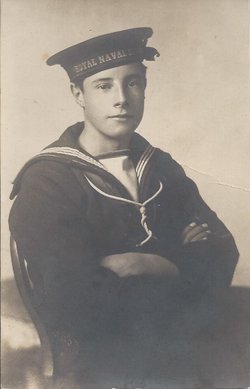
 On leaving School, Kenneth went to Cranleigh School in Surrey, where he spent two years and one term in the school O.T.C. leaving there in 1914. In November of that year Kenneth enlisted in the Royal Naval Division, 5ft 8" tall, brown hair and brown eyes. He was originally in the RND Public Schools Battalion, but on  3rd May 1915, he transferred to the Hawke Battalion, D Company, 1st Naval Brigade, at Blandford Training Camp.The Battalion left Blandford on 9th May for service abroad and on 17th May arrived at Mudros Harbour in preparation 

for landing at Cape Helles, Gallipoli on 28th/29th May. D Company spent their first days on fatigues, digging on communications trenches well behind the front line, but on 4th June the Royal Naval Division was tasked to attack the Turkish lines near Krithea. The 2nd Naval Brigade was in the forefront and the 1st Naval Division was in reserve. The attack was a disaster brought about by the failure of the French Colonial troops on the right to advance, which left the Brigade's right flank exposed and subject to intensive flanking fire from the Turks causing devastating casualties. The 1st Naval Brigade was ordered up to relieve the 2nd in the old front line and the Hawke Battalion went up to the old Naval Division trenches on 5th June. Although a counter attack from the Turks was expected, fortunately none came and the Battalion was relieved on 8th June and returned to rest camp. Returning to the front line on the 14th, the Battalion was ordered to push forward the line by the taking and holding of an advanced Turkish trench which was believed to be lightly held. This was taken at 2.30 a.m. on the 19th but counter attacks and fire from the Turkish trenches dominating the position caused heavy casualties. Volunteers from D Company took out ammunition and rifles to the survivors but it became clear that the position could not be held and the order to withdraw came just after dawn. At some time during this operation Kenneth was wounded severely in the head and left foot and was taken to the No. 1 Australian Hospital, Lemnos. On 3rd July, he embarked on the "Dunluce Castle" for the 21st General Hospital, Alexandria, having contracted septicaemia and being classed as dangerously ill, and on 4th August was invalided home and admitted to the Admiralty Haslar Hospital at Gosport on the 15th.
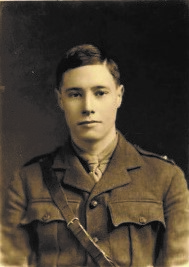
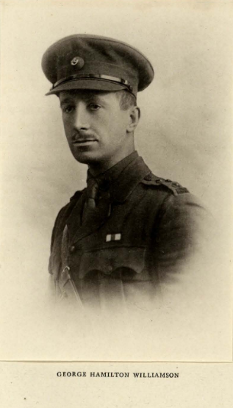
Kenneth was discharged from hospital on 1st October and posted to the 3rd Reserve Battalion at Blandford and on the 2nd was granted leave until 30th October. On 24th January 1916 he was discharged from the 3rd Reserve Battalion to obtain a commission in the 28th London Regiment (Artists Rifles) OTC, which was based in France near St Omer.
Kenneth embarked at Southampton on 3rd March, disembarking at Rouen on the 5th and joining his new battalion on the 6th at St Omer. The next few months were spent in training, guard duties and fatigues, while men were sent to and from Cadet School. On 15th July, Kenneth was promoted to Lance Corporal (unpaid) and on 18th September to Lance Corporal (paid). In October he was attached to the 2/4th Gloucester Regiment for a course of instruction from the 2nd to the 24th, with 1 officer and 11 other ranks. At this time the Gloucester Battalion was in the the Neuve Chapelle sector and spent two spells in the front line during the course of instruction.
Kenneth obtained his commission on 4th January 1917, and, as a temporary Second Lieutenant, was posted to the 7th King's Royal Rifle Corps, 41st Brigade, where his brother George was serving as a Captain, in the area south of Arras. In January the Battalion was in a quiet sector of the line and most of February and March was spent in reserve, undertaking training and sports.
On 22nd March the Battalion marched to billets in Arras and on the 24th found itself in support of the 8th Battalion. On the 28th the Battalion relieved the 8th in the trenches, about 800 to 1,000 yards from the German lines. The Battalion suffered considerable shelling and 3 other ranks were killed and 10 
wounded.  The Battalion was relieved on 1st April and moved back to reserve. The Battalion was to take part in the Battle of Arras, a series of offensives planned by the British Army between 9th April and 16th May 1917. The 41st Brigade was to be in reserve, while the initial attack was to be carried out by the 42nd and 43rd Brigades. The bombardment of the enemy trenches commenced on 5th April unceasingly day and night and on 8th April the Battalion commenced their movement up to their positions. On the 9th the attack proceeded satisfactorily and the Battalion was not required during the day. On the 10th at 11 a.m. they were ordered up to relieve the 43rd brigade and, after passing the original German front line, they suddenly came under machine gun and rifle fire from the right flank. Under cover of a snowstorm, A and D Companies, under the command of Kenneth's brother, George, rushed forward and secured the objective of the previous day's attack. However heavy casualties occurred, 3 officers were killed and 6 (including George and Kenneth) wounded and some 60 Other Ranks killed and wounded. The night was quiet but the following day, the Battalion was ordered to push forward, in impossible circumstances, and this failed with more heavy casualties. The Battalion was relieved on 12th April and returned to billets in Arras. Over the 4 days the Battalion suffered casualties of 12 officers  and 186 other ranks killed or wounded. 
Kenneth and George would have been evacuated to a Casualty Clearing Station behind the lines on the 10th or 11th April. Unfortunately George succumbed to his wounds on the 12th, at 20th Casualty Clearing Station, and is buried at Warlincourt Halte British Cemetery, some 22 km south west of Arras, Plot VIII Row F Grave 2. This cemetery was used by the 20th and 43rd Casualty Clearing Stations.
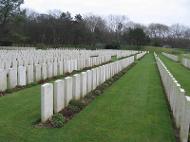
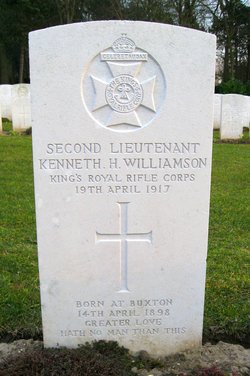
Kenneth, after initial treatment, was transferred by rail to the St. John's Ambulance Brigade Hospital at Etaples but he was unable to be saved. Etaples and the immediate countryside was the scene of  immense concentrations of hospitals, some 16 being present. He was buried in Etaples Military Cemetery, Plot XVIII Row E Grave 7. This is the largest cemetery of the Commonwealth War Graves Commission, containing 10,771 Commonwealth burials of the First World War. Probate was granted to John Harper Williamson, gentleman, effects £46.
A fellow officer wrote to his parents describing the action in which he fell: "Kenneth himself, with his platoon, pushed on a little under cover of a bank. He then told Sergt. Smith to detail four men to go out with him (Kenneth) to locate the machine gun. They crawled out under heavy fire; they had to cross a small rise in the ground, and were almost on the skyline, so I am afraid they must have been easy targets. Of the four who went with him two were killed and two wounded. They located the machine gun, and we were able next day to turn the artillery on to it and finally make it leave."


  THE HULMEIAN - July 1917

  Second Lieutenant KENNETH H WILLIAMSON, Kings Royal    Rifles, died of wounds on April 12th. He had served as A.B. in      the R.N. Division at the Dardanelles, and was wounded there,      afterwards obtaining a commission in the Army. He was at            School in 1910 and 1910-1911.

Make a free website with Yola